
Currently Empty: ₹0.00
CBSE
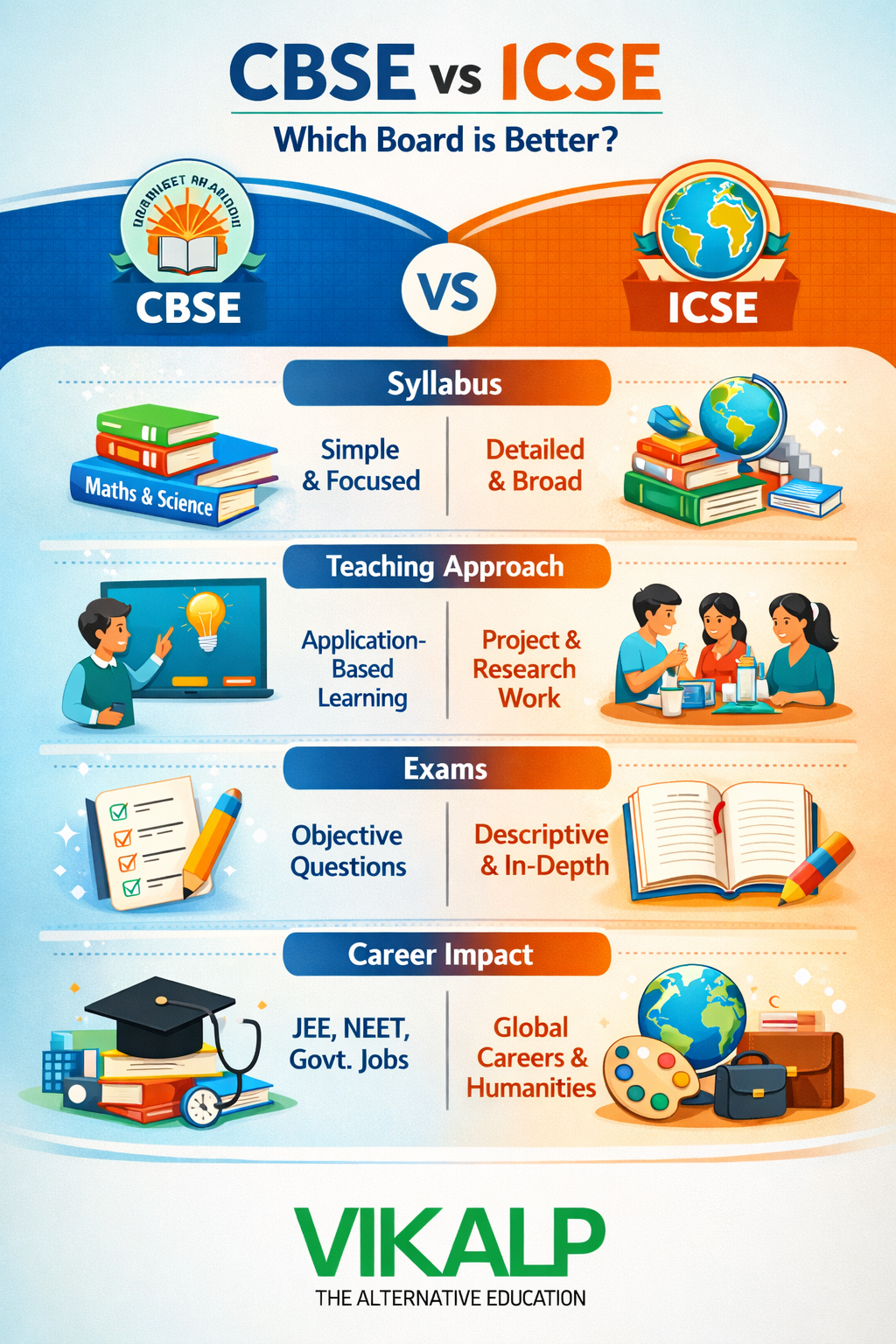
CBSE vs ICSE – 4 Clear Winning Differences
Introduction
Choosing between CBSE vs ICSE is one of the most crucial academic decisions for parents in India. Both boards provide quality education but differ significantly in teaching style, syllabus depth, evaluation system, and long-term career opportunities. While CBSE emphasizes application-based learning and national-level exam readiness, ICSE focuses on analytical thinking, creativity, and strong language skills. This guide offers a detailed CBSE vs ICSE syllabus difference and helps parents make an informed decision suited to their child’s goals.
Overview of CBSE and ICSE
CBSE (Central Board of Secondary Education) operates under the Government of India and follows a uniform national curriculum. It’s especially preferred by families who relocate frequently, as CBSE schools are available across India.
ICSE (Indian Certificate of Secondary Education) is conducted by the CISCE (Council for the Indian School Certificate Examinations). It offers an internationally recognized curriculum with strong emphasis on English, creativity, and holistic development.
For more educational insights, visit Vikalp India or explore our Best Online School page.
Key Differences Between CBSE and ICSE
| Feature | CBSE | ICSE |
|---|---|---|
| Learning Approach | Application-based | Analytical and detailed |
| Syllabus | Simple, concise | Deep, broad coverage |
| Assessment | Objective and case-based | Descriptive and analytical |
| Best For | Competitive exams (JEE, NEET) | Global education and language mastery |
Syllabus Structure
The CBSE syllabus is concise and exam-focused, designed to reduce stress and align with national entrance exams. In contrast, the ICSE syllabus covers subjects in greater depth, including detailed explanations, project work, and creative tasks.
Teaching Style
CBSE teachers emphasize clarity of concepts and practical application. Lessons are structured, efficient, and aligned with real-world problem-solving. ICSE teaching, on the other hand, focuses on discussions, project-based learning, and creativity. Students often engage in experiments, debates, and research presentations — nurturing communication and analytical skills.
Assessment Pattern
CBSE follows a balanced approach of internal assessments and final board exams featuring multiple-choice and case-based questions. ICSE places heavier weight on project work, practicals, and descriptive answers that encourage deep understanding and critical thinking.
Subject Highlights
CBSE Syllabus Features
- Compact, easy to revise
- Ideal for JEE, NEET, and government exam preparation
- Strong focus on Maths and Science
- Application-based and practical learning
ICSE Syllabus Features
- In-depth subject coverage
- Strong emphasis on English language and literature
- Offers broad subject choices including arts and commerce
- Widely accepted by international universities
Science and Maths Comparison
CBSE’s Science and Maths syllabus is simpler and directly aligned with national entrance tests. ICSE includes more chapters, detailed theoretical concepts, and complex numerical problems — suitable for analytical learners. This makes CBSE better for exam-oriented students, while ICSE benefits those seeking academic depth.
Humanities and Commerce Comparison
ICSE provides detailed content for humanities and commerce subjects such as History, Geography, and Economics. CBSE covers these subjects in a more concise format, helping students manage workload effectively while maintaining focus on STEM subjects.
Career Impact and Future Scope
CBSE students tend to perform well in engineering, medicine, and civil services due to the board’s exam alignment. ICSE students, with their strong English and research-based learning, excel in management, communication, and international education. Both boards open doors to success — the choice depends on the student’s career aspirations and learning style.
Which Board Is Better?
- Choose CBSE if your child aims for national-level exams like JEE or NEET.
- Choose ICSE if your child enjoys in-depth study, strong English, and diverse academic exposure.
Ultimately, the right choice is the one that aligns with your child’s strengths, interests, and long-term goals.
Conclusion
CBSE vs ICSE is not about which board is superior, but which best suits your child’s needs. CBSE ensures strong foundations for competitive exams, while ICSE develops creativity, communication, and analytical skills. By understanding each board’s syllabus, teaching approach, and career outcomes, parents can make a confident and informed decision for their child’s future.
Call to Action
Looking for the right academic path for your child? Explore personalized learning options with Vikalp India — India’s trusted online education platform connecting students with the best learning environments.