
Currently Empty: ₹0.00
School
Schools Through the Ages: 4 Amazing Revolutions
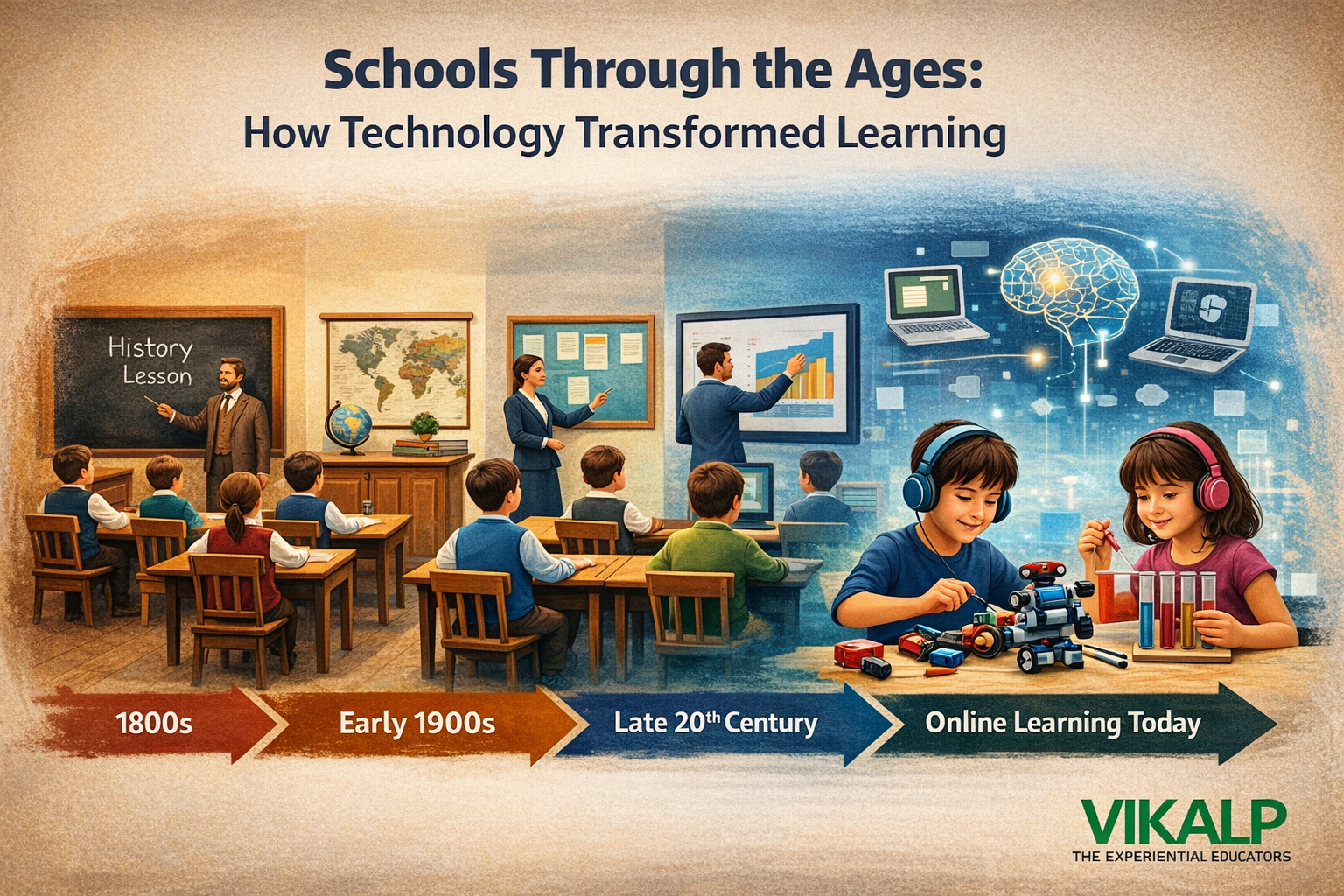
Schools Through the Ages: A Journey of Reinvention
Education has always mirrored the world’s technological progress. From chalkboards to smartboards and now AI-powered virtual classrooms, Schools Through the Ages reflect how society continuously reinvents the way we learn. Yet, for centuries, the classroom structure remained strikingly similar until now.
The First Industrial Revolution: 1760–1840
The dawn of factories powered by steam and water introduced the first formal schooling systems. Blackboards became revolutionary teaching tools, allowing one teacher to instruct dozens of students simultaneously. Classrooms began to function like mini assembly lines ~ standardized, efficient, and replicable.
The Second Industrial Revolution: 1871–1914
Electricity, railways, and telegraphs connected the world, expanding access to education. However, schools continued using the same lecture-based approach. The classroom of 1910 would feel familiar even to today’s students proof of how resilient traditional schooling was against change.
The Third Industrial Revolution: Late 20th Century
As computers and the internet reshaped industries, education tried to keep up. Smart boards replaced blackboards, but the method stayed the same: one teacher, many students, one lecture. The education technology evolution modernized tools, not pedagogy.
The Fourth Industrial Revolution: 2010 Onwards
With AI and automation transforming jobs, education entered a new era. Online and hybrid schools began to emerge, breaking the physical boundaries of the classroom. This era marks the birth of true innovation in schooling where learning can be personalized, flexible, and activity-driven.
Why Traditional Schools Struggled to Adapt
Traditional schools faced inherent challenges:
-
Class sizes of 30–50 limited hands-on learning.
-
Short 40-minute periods left little time for experiments.
-
Lecture-trained teachers found experiential methods difficult to implement.
The result? A system optimized for uniformity, not creativity.
Vikalp’s Experiment: Reimagining Learning
Vikalp India saw this gap early. Through partnerships with traditional schools, it introduced activity-based learning but systemic barriers limited progress. The breakthrough came in 2015 with the launch of Vikalp Online School, designed entirely for experiential, hands-on learning delivered virtually.
Each child received personalized kits, enabling real activity-based experiences at home. Teachers guided, rather than lectured. The results? Higher engagement, stronger understanding, and measurable improvement in learning outcomes.
Learn more about this model at Vikalp Online School.
The Covid Turning Point
The pandemic accelerated change. When schools shut down, thousands discovered Vikalp’s approach. Families realized that home-based, activity-led education could be not only effective but joyful. Even after schools reopened, many parents chose to stay online marking a shift in mindset similar to how remote work became mainstream.
The Future of Learning: Beyond Lectures and Classrooms
The future of Schools Through the Ages lies in breaking free from one-size-fits-all teaching. Most online schools today still mimic the lecture format only on a screen. But activity-based online schools like Vikalp India represent a deeper change: using technology to make learning tangible, interactive, and creative.
As AI continues to advance, education must prioritize curiosity and problem-solving over rote memorization. The classroom of tomorrow won’t be defined by walls, but by imagination.
Conclusion
From steam engines to AI, every industrial revolution has reshaped education. The Fourth Industrial Revolution is no exception but this time, it’s redefining schooling itself. Activity-based online schools are not a passing trend; they are the blueprint of future learning.
FAQ
Q1. What makes activity-based online learning effective?
It engages multiple senses, helps children learn by doing, and builds deeper understanding compared to lectures.
Q2. How does Vikalp India’s model differ from other online schools?
Vikalp’s classes use physical learning kits, small groups, and interactive teaching, not passive screen learning.
Q3. Is online schooling the future?
Yes — hybrid and activity-based online learning models are emerging as sustainable, flexible alternatives worldwide.