
Currently Empty: ₹0.00
Education
NEP 2020 Reality: 7 Powerful Classroom Truths
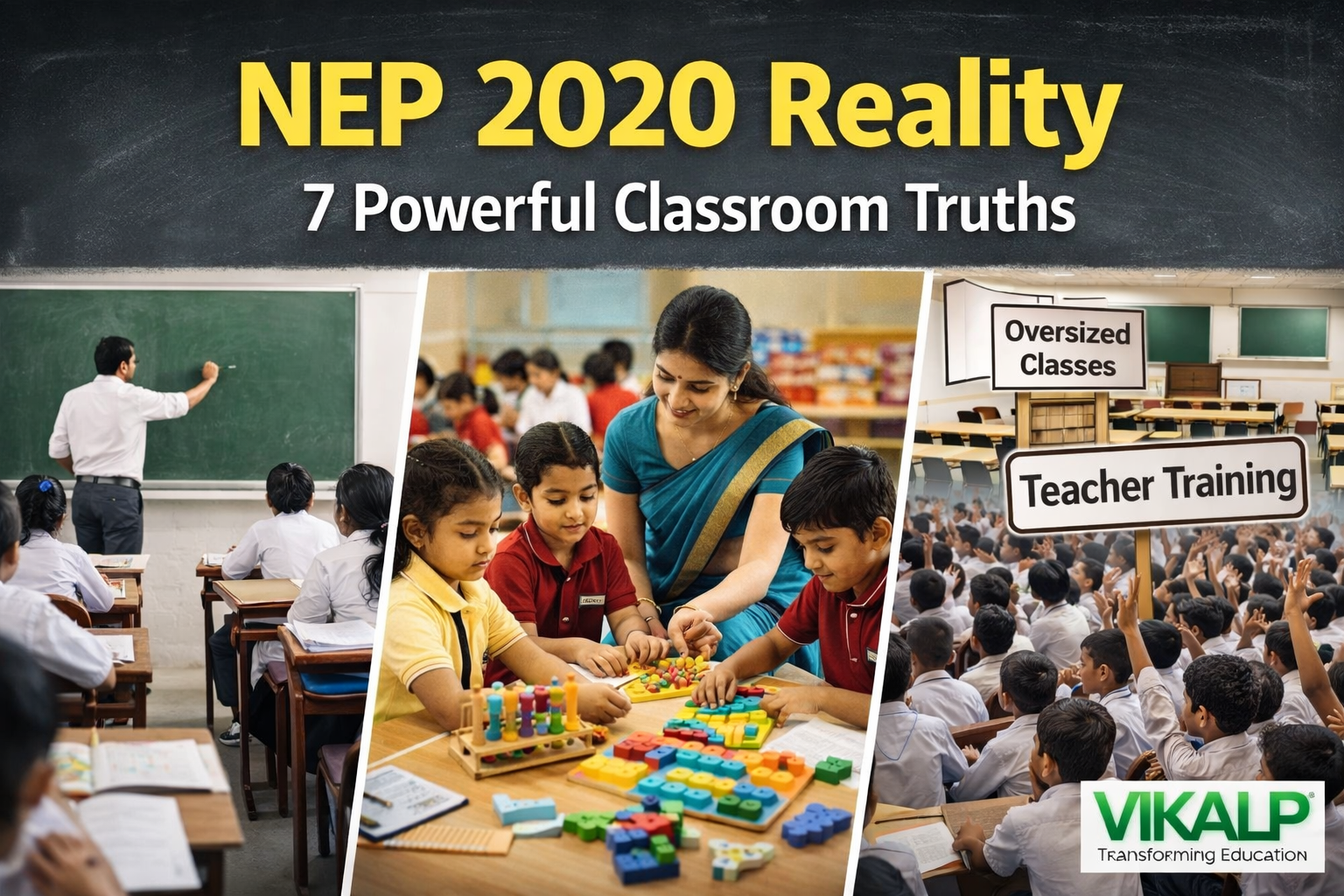
NEP 2020 Reality
It presents a bold promise for Indian education. It envisions classrooms where students actively build understanding instead of memorising facts. The policy promotes inquiry, hands-on exploration, and deep conceptual clarity. On paper, this vision is inspiring. In practice, the gap between intent and implementation remains wide.
At its core, NEP 2020 Reality rejects rote learning. It encourages activity-based learning, multidisciplinary thinking, and competency-focused assessment. Students are expected to learn how to learn, rather than simply recall information for exams. Research supports this shift. However, classrooms do not change simply because policy language does.
One of the biggest challenges is the lack of learning tools. Activity-based learning requires concrete materials – math manipulatives, science models, language kits, and structured resources. Most schools still depend heavily on textbooks and blackboards. Without tools, experiential learning becomes symbolic rather than meaningful.
Teacher preparation is another major barrier. NEP 2020 Reality assumes teachers are ready to facilitate inquiry-driven classrooms. In truth, many teacher education programs still focus on lecture delivery and syllabus completion. Few teachers are trained to design activities, manage exploration, or assess understanding through observation.
Teacher training in India needs deep reform. Without hands-on training, teachers are asked to implement methods they have never experienced themselves. This disconnect weakens the policy’s impact at the classroom level.
Class size further complicates implementation. With 30–50 students in a classroom, personalized learning becomes nearly impossible. Activity-based learning demands observation, pacing flexibility, and individual support. Overcrowded classrooms limit all three.
NEP 2020 Reality also emphasizes that learning must be constructed, not transmitted. Yet most classrooms still function on the idea that teaching equals telling. Students listen, copy, and repeat. True understanding remains limited to a small fraction of learners.
Vikalp demonstrates that NEP ideals are achievable when structure supports philosophy. Smaller class sizes, systematic learning tools, and focused teacher training allow students to engage actively with concepts. Learning becomes slower, deeper, and more secure.
The future of NEP 2020 Reality depends on practical decisions – investing in tools, reforming teacher education, and redesigning classroom structures. Without these changes, the policy risks remaining an inspiring document rather than a lived experience.