

Currently Empty: ₹0.00
Online Classes
5 Powerful Ways Multisensory Learning Works
Improving Attention and Engagement Through Multisensory Learning at Vikalp
Every child learns differently, and that’s exactly what makes education both fascinating and challenging. At Vikalp Online School, teaching isn’t about uniformity—it’s about understanding how each mind works. Kian’s journey beautifully demonstrates how a multisensory learning approach can spark curiosity, sustain attention, and build genuine engagement in young learners.
The Initial Challenge: Understanding Kian’s Learning Needs
Kian, a bright and energetic Grade 1 student, loved stories, games, and classroom discussions. But whenever abstract or theory-based lessons were introduced, his attention began to drift.
He would fidget, lose focus midway, or need frequent reminders to stay on task. His struggle wasn’t a lack of motivation—it was a challenge of attention and processing. Kian found it difficult to absorb large chunks of verbal information without visual or physical engagement.
This is a common situation for many early learners. The traditional “listen and repeat” model simply doesn’t align with how young brains absorb and retain knowledge. Recognizing this, Kian’s facilitator decided to introduce a multisensory learning method—one that would make learning feel like play while deepening understanding.
The Vikalp Teaching Method in Action
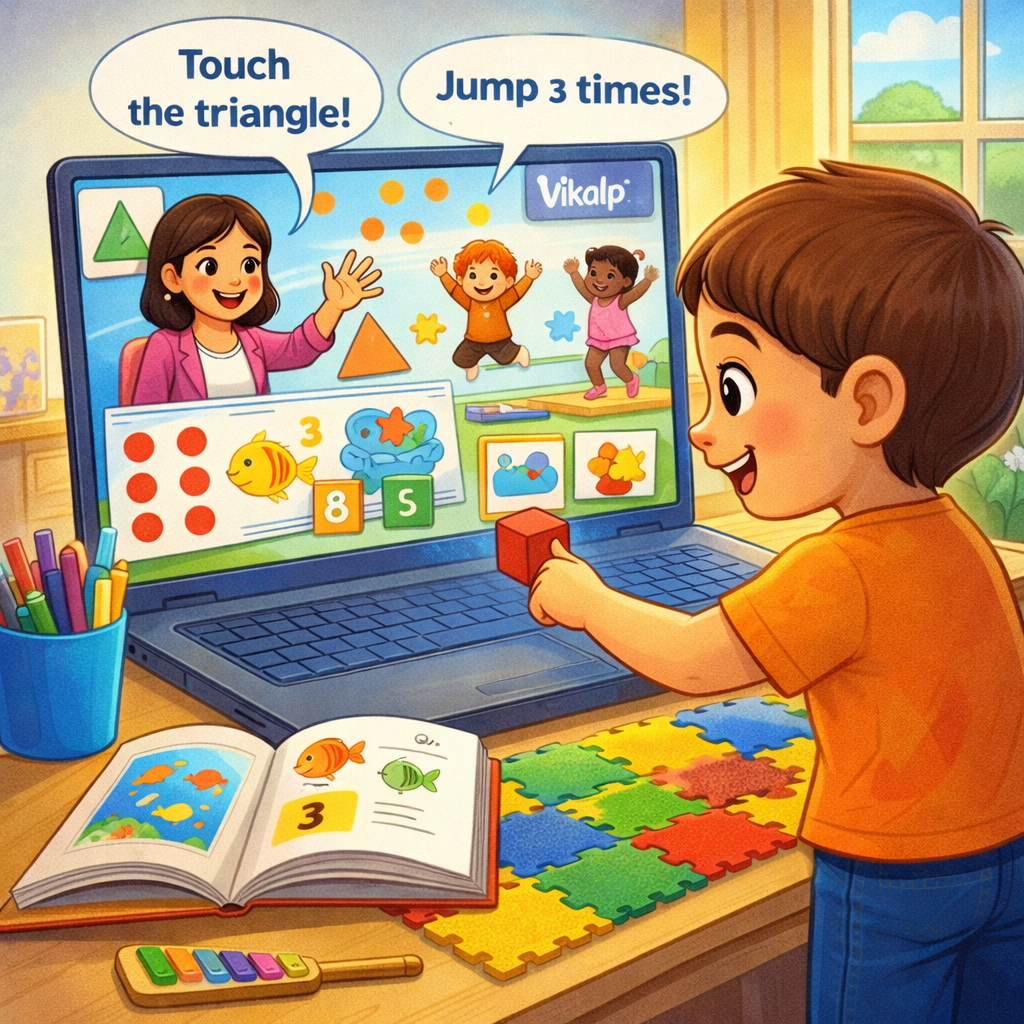
Vikalp’s educators believe in the power of engaging all senses during learning—sight, sound, movement, and touch. For Kian, lessons were redesigned to be interactive, dynamic, and filled with variety.
Here’s how Vikalp implemented multisensory learning in Kian’s classes:
-
Movement-based activities: Verbs and action words were taught through short physical games. When learning “jump,” “clap,” or “run,” Kian actually performed the actions, reinforcing memory through motion.
-
Visual prompts and short videos: Instead of reading about phonics, he watched short animations, associating sounds with colorful letters and characters.
-
Interactive digital tools: Platforms like Wordwall and Spin-the-Wheel transformed routine exercises into engaging challenges that kept him alert.
-
Turn-taking games: Activities requiring participation and teamwork encouraged active involvement, reducing passivity.
-
Positive reinforcement: Every correct response, effort, or creative attempt was met with encouragement, reinforcing confidence.
By engaging his eyes, ears, hands, and body, multisensory learning made lessons easier to understand and more enjoyable.
The Transformation – Focus Replaced Frustration
Over a few weeks, the transformation in Kian’s learning behavior was remarkable. His attention span increased steadily, and he began volunteering answers before being called upon. His confidence blossomed.
Instead of struggling to follow instructions, Kian now anticipated activities with excitement. His comprehension improved significantly because he was no longer a passive listener—he was an active participant.
When lessons engaged his multiple senses, distractions naturally faded. Learning became less about effort and more about enjoyment.
Evidence of Growth – Measurable and Meaningful
Kian’s improvement was clearly visible through daily participation and assessments.
-
✅ He answered nearly all classroom questions correctly during interactive sessions.
-
✅ Independent participation increased—he no longer waited for prompts.
-
✅ Concept clarity improved, as seen in his phonics and vocabulary retention.
-
✅ His focus was sustained throughout lessons, even during longer sessions.
Beyond academics, his self-confidence and communication skills improved as he grew comfortable expressing himself in class.
Parent Involvement – Reinforcing Learning at Home
At Vikalp, parents are partners in the learning journey. Kian’s facilitator regularly shared follow-up activities with his parents – short games, reading tasks, and small projects to reinforce classroom learning.
This continuity between home and school created consistency. Parents observed the same energy and enthusiasm at home that teachers saw online. The result was a seamless loop of learning reinforcement.
Kian’s mother remarked, “He looks forward to class every day now. He learns with joy, not pressure.”
The Bigger Picture – Why Multisensory Learning Works
Kian’s journey illustrates a universal truth—children learn best when they experience concepts rather than just hear them. Multisensory learning taps into the brain’s natural way of processing information, making retention stronger and understanding deeper.
It bridges the gap between theory and experience, helping learners of all styles—visual, auditory, and kinesthetic—stay engaged.
At Vikalp Online School, this approach is not an exception—it’s a philosophy. By combining play, exploration, and reflection, teachers create a vibrant ecosystem where learning feels natural and joyful.
Conclusion: From Distraction to Discovery
Kian’s story proves that attention challenges aren’t barriers, they’re opportunities. With the right methods, every child can transform distraction into discovery.
Through multisensory learning, Vikalp helped Kian connect meaningfully with lessons, improve focus, and grow in confidence. When learning activates all senses, education becomes more than instruction—it becomes inspiration.